Home and return
Grey BeesHome and return in the novel name a bond that survives displacement without making return safe or simple. Sergeyich recognizes his village as the shelter that sustained him, leaves it under the pressure of war, and nevertheless insists that he must come back to look after his land. The road away from home does not cancel that obligation: as he drives into the night, its apparent promise of somewhere better carries him toward Crimea and a possible new beginning, while his first home remains the place to which he expects to return.
The Home That Had Been a Fortress
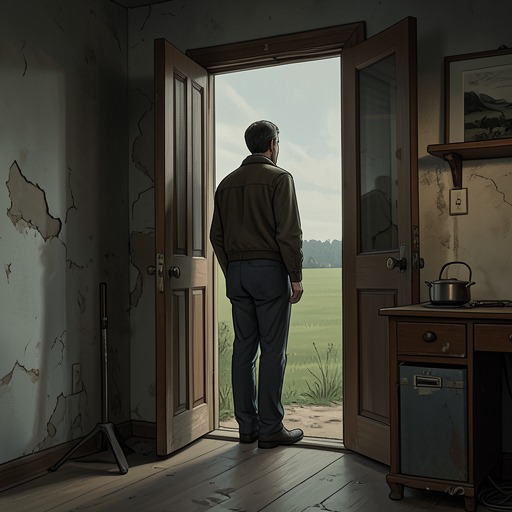
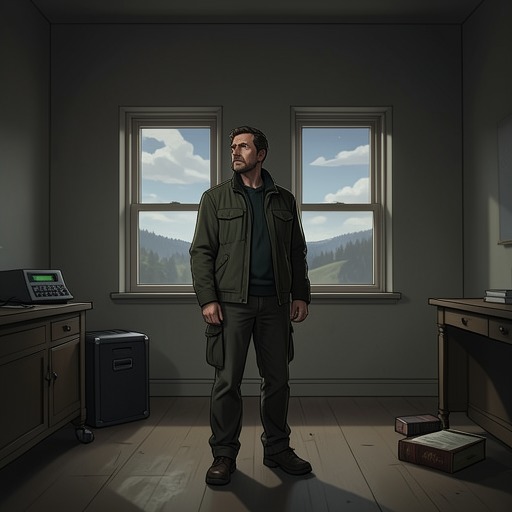
As Sergeyich prepares to leave, he looks over the walls, trees, fences, gates, doors, and windows of the place where he has lived through years of troubles. The rain falls as he takes in these familiar surroundings, and the scale of his understanding shifts: he had thought he was protecting his home, land, and world, but now realizes that they had protected him. They had been his fortress, his bulletproof vest. Leaving makes visible a dependence that daily life had kept hidden; what seemed to be a person defending his property is recast as a person sheltered by it.
That recognition gives departure its emotional weight. The house and its surroundings are not merely possessions to be abandoned in a wartime move. They form the setting in which Sergeyich has endured one day and one night after another, and their ordinary boundaries have served as a defense. Once he must go, the familiar world looks newly fragile: it remains home, but no longer offers the protection it once seemed to provide.
Leaving, and the Promise of Home
Sergeyich’s departure is practical as well as emotional. He has to prepare the beehives for transport, close their entrances so the bees do not scatter, load the hives onto a trailer, cover and secure them, and take jars of honey. The details make clear that leaving home does not mean leaving everything behind: he carries the living work of his home with him, arranging the journey around the needs of the bees.
Later, Galya asks where he will go, and Sergeyich answers that he will go home in the autumn. He does not expect the war to be over by then. His explanation is not a prediction that home will have become safe, but a statement of obligation: he has to look after his land. Asked why he would return, he cannot offer a calculation. Home is where home is, he says, and a person has to come back. The simplicity of the answer holds together attachment and duty without pretending that either can remove the danger.
The danger is already part of the landscape he imagines returning to. Sergeyich no longer plants anything in his garden because unexploded shells may be buried in the earth and hidden as the ground closes over them. He recalls an old man in nearby Svitle who blew himself up while working in his garden; the people there nevertheless keep planting. The scene makes the conflict in Sergeyich’s promise concrete: the land he feels bound to tend can conceal lethal remnants of war, and cultivation continues in its shadow.
The Road and the Unchosen Destination
The road away from the village opens a different possibility. After leaving Galya, Sergeyich drives through the night along an empty route that calms him, passing turns where he might have stopped and found a quiet place to pitch his tent and settle the hives. Instead, the deserted road seems to push him onward, as though going farther must mean going somewhere better. At a junction, the signs point toward Donetsk and Melitopol; then his headlights reveal a sign for Simferopol.
The discovery that he is almost in Crimea shocks him, but the shock is happy, like unexpectedly finding money in the street. The turn toward Crimea is not presented as a decision that erases his earlier declaration about going home. Rather, the road’s momentum carries him into an unplanned possibility, and the thought of Akhtem, a Crimean Tatar he befriended at a beekeepers’ convention years earlier, gives that possibility a human connection. Return remains the direction of Sergeyich’s stated loyalty; the road, meanwhile, takes him somewhere he had not set out to reach.
Belonging Without Resolution
The idea of home is built through a tension between rootedness and movement. Sergeyich’s native walls and trees once protected him, but the war makes it dangerous to work the soil; he leaves, but defines leaving as temporary and measures his future against coming back. Even the transported hives connect departure to continuity: his home’s labor and its living inhabitants travel with him, though they cannot make the journey equivalent to staying.
The novel does not resolve the tension by making either the village or the road a secure substitute for the other. Sergeyich’s insistence that he must return persists alongside his uncertain route toward Crimea. Home is at once a particular land he is responsible for and a bond that remains active in his absence. The journey therefore ends this part of his story not with a return, but with a change in direction: displacement carries him onward, while the promise of home continues to pull him back.